Share

Showing posts with label Solar System. Show all posts

Sunday, October 1, 2017

Planet of the Cats

“Planet of the Cats”
Last night, Bluebell stepped in front of the TV at THE perfect moment!

LOLOLOLOL!
No automatic alt text available.😂

Saturday, November 26, 2016

Happy Five-year LAUNCHIVERSARY to Mars Curiosity!

Five years ago today I got to attend the launch of the Mars Curiosity rover! It solidified my enthusiasm for work in social media and gave me the confidence that also led to applying and becoming a NASA/JPL Solar System Ambassador! I'm sure all of us #spacetweeps that went still feel like it's OUR rover! :-) Here are some of my photos from that experience!
1. LINK-one
2. LINK-two
It was an amazing week. I met so many people from all walks of life who had my same space interests and excitement. We met scientists and engineers who worked in the Mars Science Laboratory (MSL) and on Curiosity! We also got to meet several astronauts and members of NASA administration including Charles Bolden. Even though I had lived much of my life along the I-95 corridor, I'd never been to Kennedy Space Center or seen Cape Canaveral.
NASA basically treated us like rockstars and was INCREDIBLY wonderful. Our job for all the lectures we attended, scientists from the MSL team that we met, visiting the launchpad, and watching the launch from reserved seats - was to get out on social media platforms what we were learning and be the voice of the public for NASA and the space program. In addition, many of us took back educational resources to our schools and communities. Eyes on the Solar System is one such fabulous example.
PLUS, Mars is amazing and I believe that we should all support space programs!

#space #Mars #JourneyToMars


Friday, May 13, 2016

The Fantastic Flaming Fabulosity of Our Sun

Dear Gigantic Flaming Ball of Hot Gas, 
Churning in space, around which our entire solar system exists, I'm glad you're here!
The Sun - Basic Facts and awesome photos - https://www.nasa.gov/sun
The recent Mercury transit got me thinking of all of my favorite images of the Sun. I decided to put a few together and WOW! They are stunning!
I recently saw an incredibly detailed picture of a sunspot and I truly couldn't believe the clarity! This image below simply takes my breath away! It is from 2002 and was the APOD for Nov 14th that year. http://apod.nasa.gov/apod/ap021114.html
APOD Nov 14, 2002 Credit: SST, Royal Swedish Academy of Sciences
I love the pictures that I get from Astronomers occasionally via twitter!! They use all sorts of filters. Below is a collage of two of my favorite solar prominence shots from @FogBoundTurtle (Claude D.), an amateur astronomer, photographer from Burnaby, BC. claudedesrosiers.smugmug.com 
Images from Claude Desrosiers, Burnaby, BC
Here is a great one of the solar surface, also by @FogBoundTurtle
http://claudedesrosiers.smugmug.com/Nature/Astronomy/i-FffwwqK

Speaking of twitter (and Facebook), get to know Camilla Corona (Space Chicken), the mission mascot for NASA's Solar Dynamics Observatory, a super fun sciencey chicken that worked at the NASA Goddard Space Flight Center and is a STEM Ambassador at the Stanford Solar Center! @CamillaSpace is her Twitter handle!
I LOVE this next image from the Stanford Solar center! It has beautifully merged solar images into a quilted sun :-) It was their webpage cover! Clever!
Home page of the Stanford Solar Center
This next one is a solar prominence in X-Ray view from NASA
http://ixo.gsfc.nasa.gov/resources/imagesAstronomyScience.html
NASA X-ray images
AND from NASA's SDO - Solar Dynamics Observatory - At first light on April 21, 2010, the first photographs from the SDO were received. A WOW view of the high-definition sun was that of a dramatic prominence; an arc of solar plasma rising into the sun's corona. Here is a link to three year's worth of NASA SDO Images in video form with explanation!
http://www.nasa.gov/mission_pages/sdo/news/first-light-3rd.html
NASA SDO images
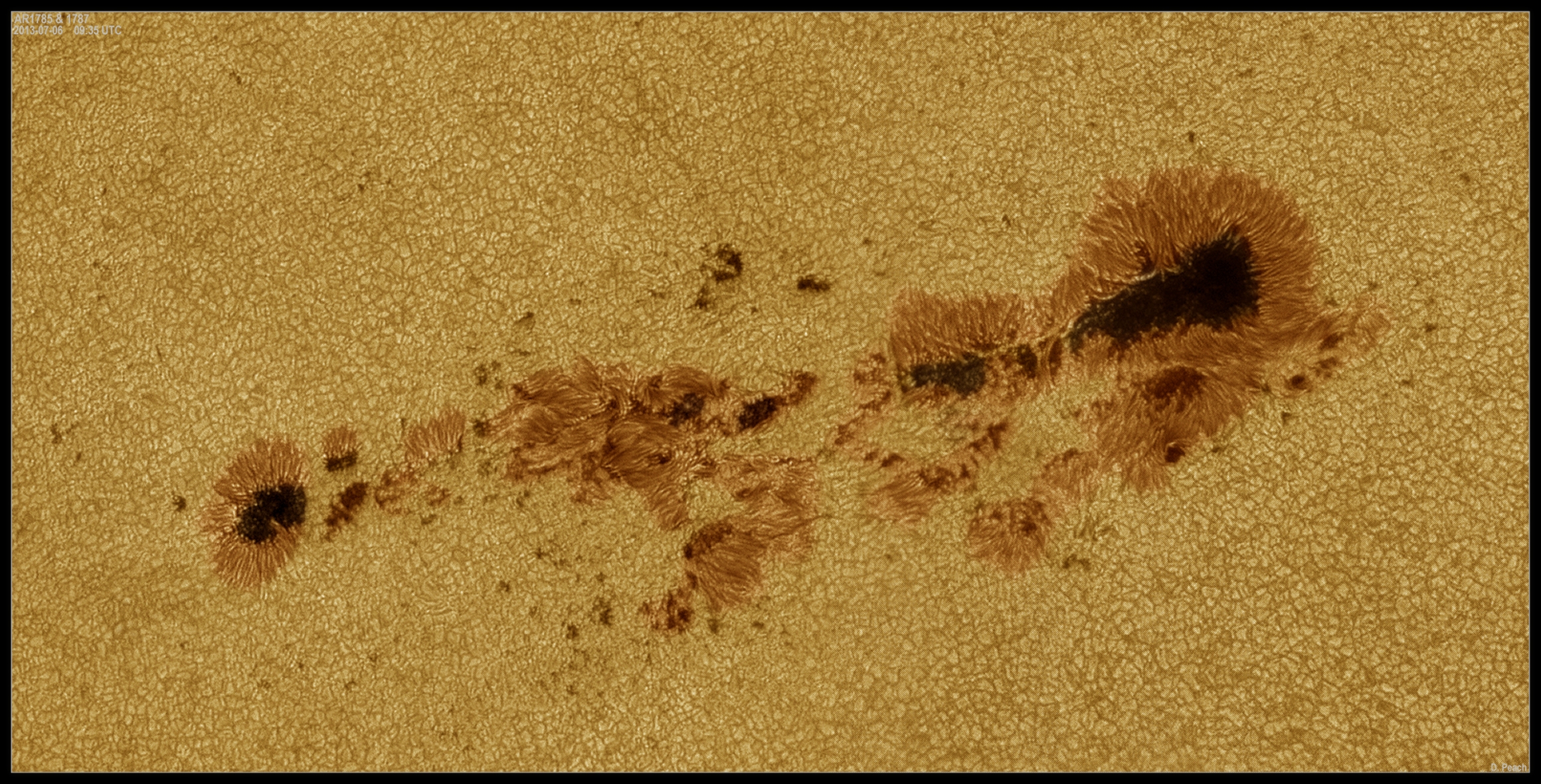
Another fabulous APOD - from July 2013  This image below features sunspots crossing the sun. I still cannot believe the clarity and detail! Here is the explanation, directly from APOD
"Explanation: One of the largest sunspot regions in recent years is now crossing the Sun. This region of convoluted magnetic fields may well produce a solar flare that releases a cloud of energetic particles into the Solar System. Were a very powerful cloud to impact the Earth's magnetosphere, it could be dangerous to Earth-orbiting astronauts and satellites. Conversely, the impact of even a less energetic cloud might create picturesque auroraThis is the sunspot region as it appeared two days ago. The rightmost part of this region has been cataloged as AR 11785, while the left part as AR 11787. The darkest sunspot regions contain nearly vertical magnetic fields and are called umbras, while the surrounding bronze regions -- more clearly showing stringy magnetic flux tubes -- are called penumbras. Churning solar granules, many about 1000 km across, compose the yellow background region. No one knows what this sunspot region will do, but space weather researchers are monitoring it closely." ~ APOD
Image by Damian Peach - http://www.damianpeach.com/about.htm
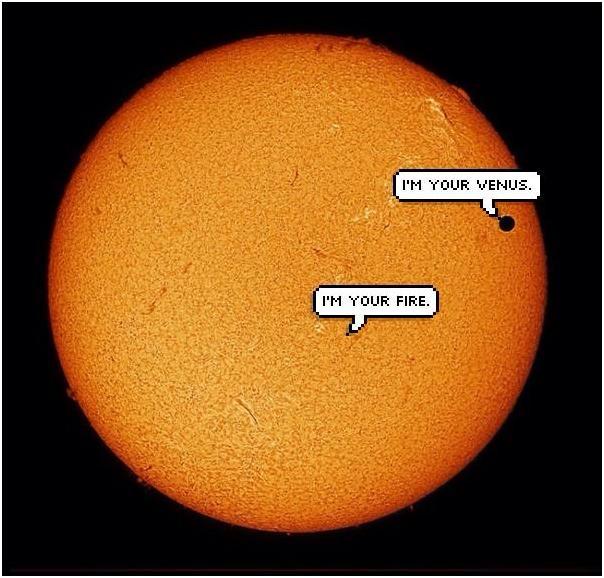
The final one I'll post today is of the 2012 Venus transit. This image is by NASA SDO and shows the entire transit sequence! Here is the www.SPACE.com info on the image:

"About this Image
On June 5-6 2012, SDO collected images of one of the rarest predictable solar events: the transit of Venus across the face of the sun in this cool space wallpaper. This event happens in pairs eight years apart that are separated from each other by 105 or 121 years. The last transit was in 2004 and the next will not happen until 2117. This image was captured on June 5, 2012." ~ via www.space.com
NASA SDO Venus transit, 2012
 - http://www.space.com/16026-sdo-ultra-high-definition-view-2012-venus-transit-path-sequence.html
Lastly, the recent MERCURY TRANSIT! #MercuryTransit! It was amazing! I watched it via the Slooh Space Camera online and just left it open on my UNO desktop while I was cleaning my office. Here's the Space.com article and here is a link to more Mercurial fabulosity.

I'm sure I'll post more sunspot fabulosity at some point. Living with a mid-sized whitish decently-healthy star is awesome indeed!
Just for fun.....see below! HAHAHA! :-)

Friday, January 22, 2016

Jan. 22 Midnight Moon

Last night / this morning around midnight, the beautiful moon peeked through a windy sky full of cloud cover. These are three of my photos from my Canon Powershot 50x zoom :-)
I love that little camera! These I've posted here are copied from my FB post so quality isn't as fabulous as the raw file on my laptop at home, but still looks decent enough.


Monday, November 23, 2015

NOLA November Moon

Some of my photos of this evening's almost-full moon, November 23, 2015. Canon Powershot, 50X zoom. Not too shabby for an automatic!
Photo by Caroline Carson

Thursday, April 23, 2015

Dear Hubble Space Telescope, THANK YOU for 25 years of space goodness!

Dear Hubble Space Telescope,
I just wanted to say a GIGANTIC THANK YOU to
Edwin Hubble, to NASA, to all of your teams (design, engineering, science, vision, launch, maintenance etc.) for 25 years of SPACE GOODNESS!
Seriously, our lives have changed for the better because of your eye into the universe!
Love,
@The_SolarSystem and friends

Follow The Hubble Space Telescope on Twitter
@NASA_Hubble
@HUBBLE_space
@HubbleTelescope

25 Articles and Links to check out about Hubble's 25th anniversary! #Hubble25
- The Hubble Site - Hubbly goodness
- The Hubble Space Telescope GALLERY - indescribable awesomeness
- NASA's Mission page for Hubble
- Unforgettable Hubble Space Telescope Photos  ~ via NY Times
- The Hubble Space Telescope, a Terrific Comeback Story  ~ via The Guardian
- Mind-boggling Images from 25 Years of the Hubble Telescope ~ via Mashable
- Some wiki Hubble info
Hubble Telescope Celebrates 25 Years in Space With Spectacular New Image 
         ~ via Universe Today
Hubble at 25: Space Telescope's Top Science Discoveries ~ via Discovery News
- NASA unveils 25th anniversary image for the Hubble: Celestial fireworks in a bed of 
         new stars  ~ via The Washington Post
- Still sharp, Hubble Space Telescope turns 25 with a cloudy future ~ via Washington Post
25 Years of Cosmic Treasures: Hubble’s 12½ Greatest Hits  ~ via Phil Plait at Slate
Hubble Space Telescope marking 25th anniversary in orbit   ~ via Boston Herald
Hubble Investigates Ghosts of Quasars Past  ~ via Sky & Telescope
- Hubble Space Telescope Turns 25 [Video]  ~ via Wall Street Journal
- Hubble Space Telescope Turns 25  ~ via CNN
- NASA's GOOGLE post about Hubble's 25th and ACTIVITIES running through April 26th
- NASA's Kennedy Space Center Celebrates Hubble Space Telescope's 25th Anniversary
        ~ via NASA.gov
Hubble Space Telescope: Pictures, Facts & History  ~via Space.com
Edwin Powell Hubble - The man who discovered the cosmos  ~ via HST
- PBS: People and Discoveries, Edwin Hubble  ~ via PBS
The Hubble Effect's 25th Anniversary --"A Radical Transformation of Our Perception of 
         the Universe"  ~ via The Daily Galaxy
Behind the Scenes of the Last Mission to Repair the Hubble ~via The Smithsonian
-
Fascinating Photos Take You Behind the Scenes of Hubble  ~via WIRED
10 Fascinating Facts About the Hubble Space Telescope  ~ via History 
Star Cluster in Nebula NGC 3603
http://hubblesite.org/gallery/wallpaper/pr2007034b/1280x800_wallpaper/

Wednesday, October 29, 2014

@The_SolarSystem is NOW ON FACEBOOK TOO :-)

OK, I finally (and happily) caved in and made a Solar System FB page. A number of my twitter peeps have been asking for it and that makes me very happy! I'm planning super interesting articles and awesomely stunning space photos etc. I invite you to give it a "LIKE" if you'd be so inclined You should also like the official NASA Solar System Exploration FB page so give that some love too! 

Here is the link to my small (but good) potatoes page.
https://www.facebook.com/SolarSystemAmbassador

Sunday, June 8, 2014

Exploring God's Wonder and Mystery

God, grant as we discover the fascinating wonders and mysteries of the universe, we may come to know you more truly! Amen. 
Voyager's Neptune
Composite Image Credit & Copyright: Assembly/Processing - Rolf Olsen,
Data - Voyager 2, NASA Planetary Data System

An Evening Prayer

God, grant as we probe the wonders and mysteries of our own solar system, we may come to know you more truly! Amen.

Friday, July 26, 2013

Stalking Voyager - Has Voyager Left the Solar System Yet?

Are we there yet?

That, my friend, is a marvelous question, but it would seem that we are not yet there.
http://voyager.jpl.nasa.gov/spacecraft/

WHEN will we be there? When will Voyager have escaped our solar system? What are they waiting on? Isn't it far enough away from our sun to qualify as "out"?

Indeed, a few of the criteria have been met already. See my previous Voyager blog post for some background info and read on for more info.

Heliosphere - our solar "bubble", the region of space our sun influences

Termination shock - the point in the heliosphere where the solar winds slow to the speed of sound because of interactions with the local interstellar medium causing compression, heat, and This is "shocking" because of the differences in speeds between slowing solar wind particles and other solar particles being regularly emitted.

Heliopause - the boundary where our sun's solar wind particles / energy ends and the interstellar medium increases. So far, I think this is a theoretical boundary, not yet witnessed, but assumed to be there. I wonder how it looks now that we know our solar system has a tail...

I'm not ashamed to admit I have been stalking Voyager data lately.

You can too! Below, there are exciting article links with recent info and links to new data being downloaded daily from Voyager.  I check the second data link (the one with charts!) almost every day. Why? Well, this is my FAVORITE SPACECRAFT and  IT'S GETTING VERY CLOSE to being declared interstellar and I believe that IT'S IMPORTANT FOR HUMANITY that we be keenly and proactively interested in interstellar exploration / travel / research. It could be ANY DAY NOW that the official declaration occurs and I for on plan on celebrating!

CRITERIA FOR BEING DECLARED INTERSTELLAR

1. A steady drop in collisions with low-energy particles from our sun. CHECK
2. A steady rise in collisions with high-energy particles from beyond our system. CHECK
3. Change in magnetic field direction from our sun to interstellar field beyond. NOT YET

So there you have it.
We are all waiting on a magnetic field direction change. This is where the magnetic highway comes into play. It is like a path along which particles are socializing and walking in and out. In other words: it's a GREY AREA and not a brick wall type of boundary that makes up our "edge".

Where to look for new data?

1. http://voyager.jpl.nasa.gov/science/Voyager_Science_Data.html Has several different types of data and link to each scientific organization and monitoring system

2. Here are the six-hour charts I love: http://voyager.gsfc.nasa.gov/heliopause/data.html
" The Cosmic Ray Subsystem team has made available 6-hour, 24-hour and 26-day data listings and yearly plots for 14 Hydrogen and Helium intensities and two counting rates. The following links will take you to interfaces which will allow you to select the data of choice. The entire Voyager data base consisting of approximately 165 rates and intensities is also available from our ARCHIVE."

No one knows exactly what our solar bubble / membrane looks like, but now we know that it is surrounded by an area with magnetic bubble pockets, an area now known as the magnetic highway and that our solar system actually has a "tail".

Here are links to recent interesting articles:

Our Solar System's Edge is "less edgy" - http://www.guardian.co.uk/science/2013/jul/09/nasa-voyager-solar-system-edge

Solar System's Edge - http://www.bbc.co.uk/news/science-environment-23075332

Magnetic bubbles - http://www.nasa.gov/home/hqnews/2011/jun/HQ_11-174_Voyager_Update.html

Magnetic highway - http://www.nasa.gov/mission_pages/voyager/multimedia/pia16486.html

Solar System Tail - http://www.universetoday.com/103412/our-solar-system-has-a-tail-shaped-like-a-four-leaf-clover-new-findings-from-ibex/

Solar System Has a Tail - http://www.sciencenews.org/view/generic/id/351477/description/News_in_Brief_The_solar_system_has_a_tail

HAPPY DATA STALKING! ;-)

Monday, October 8, 2012

Voyager 1 in Interstellar Space? Has Elvis Left the Solar System?

Has Elvis left the Solar System?

Voyager 1 and 2, both launched 35 years ago in 1977, have been making big news lately and it is very possible that NASA might be making an official declaration soon about the probe....
Voyager 1 is about to make history for humanity as it has most likely left our solar system and is now in interstellar space. This isn't just exciting, it's TREMENDOUSLY EXCITING and HISTORIC for the human race! I myself am an incurable fan of both Voyagers and this post is to share some very recent info about them and also to review the basics for those who may not be familiar with the mission. Below (public domain image), is the Voyager 1 spacecraft.
Here's is a link to some of the latest info as of Oct 4th, 2012:
Houston Chronicle Post: http://blog.chron.com/sciguy/2012/10/more-evidence-that-voyager-has-exited-the-solar-system/ by Eric Berger.

To me, the most exciting portion of Mr. Berger's post is the second chart (posted below) which shows a massive drop and continuous lowered amount of ionized particles from our Sun. The actual boundary crossing could have happened as evidenced by that and the raised level of highly energetic galactic cosmic rays the prob is reading. Those have been on the rise for a while. Another aspect to consider is the flux of the magnetic field. All these are elements have effectively been observed during the past few months.

Here is the link to several charts and VOYAGER RECENT 6-hour HISTORY - http://voyager.gsfc.nasa.gov/heliopause/recenthist.html

Where do we draw the line?
No one knows the exact boundary of our solar system........yet! Isn't that amazing?! What does our membrane look like? How permeable is it? Is it degrading? How much does the boundary shift and does it shift with our sun's wobble or with our system's wobble in and out of the arm? I'm looking forward to hearing some of those answers one day and hope that it will be in my lifetime. I personally imagine the boundary to be rather vague in spots and constantly shifting in minute details. An interesting thing to remember is that Voyager 1 and Voyager 2 are at different places so while similar shifts are expected, we might have something striking from one that the other doesn't find. In Berger's article, you'll see more charts and criteria for Voyager to be considered "out" of our solar system.

They include the following, (from Berger's article:)

Quote: "At last check, NASA scientists said they were not yet ready to officially declare that Voyager 1 had officially exited the solar system by crossing the heliopause.
To cross this boundary scientists say they would need to observe three things:
1. An increase in high-energy cosmic rays originating from outside our solar system
2. A drop in charged particles emanating from the sun.
3. A change in the direction of the magnetic field.
End Quote"

The Voyagers are going where no man.......
and no spacecraft have gone before!
There are a great many people who don't get how fantastic that is. They have been somewhat dulled to a host of real scientific discoveries due to their less "flashy" nature when put up against Star Trek, Star Wars, and recent decades of space and sci-fi special effects and computer-generated environments. Adventures of slow-spinning, silent, old technology spacecrafts often get a bit forgotten by those not actively looking right at the space community and those researchers.

Voyager 1, in continuing its trek toward the heliosphere, arrived last year and found a layer of magnetic bubbles made up of charged particles. Now, it is 11 billion miles away and suspected to have crossed the boundary of the heliosheath (the outer region of the heliosphere). Here are two articles about those cool magnetic bubbles:

"NASA Probes Suggest Magnetic Bubbles Reside at the Edge of the Solar System" http://www.nasa.gov/home/hqnews/2011/jun/HQ_11-174_Voyager_Update.html

"A Big Surprise at the Edge of the Solar System - http://science.nasa.gov/science-news/science-at-nasa/2011/09jun_bigsurprise/

Some Perspective...
With the completion of the original mission of exploring Jupiter and Saturn on planetary flybys, Voyager 2 was directed to check out Uranus and Neptune while Voyager 1 maintained a trajectory toward the edge of our "neighborhood" bubble. To give you some perspective, our solar system is located in the Orion-Cygnus arm of our galaxy, the Milky Way. Our bubble wobbles up and down in and out of our arm area, but is still very...VERY far away from our galactic center. Just think: it took 35 years to exit our solar system. Even if we use the very latest technologies and don't stop for any sight-seeing, it is unlikely that any of us will be around to see any craft approach our galactic center. Check out this link to see the real time position of both Voyagers: http://voyager.jpl.nasa.gov/where/index.html (Is that not THE COOLEST!?)
If it isn't, then this may be - check out the scale of the Universe to give you even more perspective: http://scaleofuniverse.com/

Above: We are the YELLOW DOT - image from http://en.wikipedia.org/wiki/Milky_Way
Below: image from this website: http://www.outerspaceuniverse.org/our-solar-system-boring-part-milky-way-galaxy.html
How long will the Voyagers last? How far can they go?
Physically, they should last millions of years, but communications will probably only last until about 2025. The Voyagers are powered by large radioscopic thermoelectric generators containing plutonium. Operations will cease one at a time, barring any unknown circumstances. Here is the master plan of the ending of the mission and the scheduled operations:
http://voyager.jpl.nasa.gov/science/thirty.html From the timeline, it looks as if Voyager 1 is expected to live slightly longer than its sister Voyager 2.

Having followed the Voyager probe missions since I was a child and being inspired by watching Carl Sagan in Cosmos: A Personal Voyage on TV in the 80's, I have always been fascinated with space and any aspect of the night sky. Humanity has always looked up and in spite of the terribly too-bright skies over New Orleans, I am always looking up. One day, hopefully sooner rather than later, I hope to purchase a telescope.

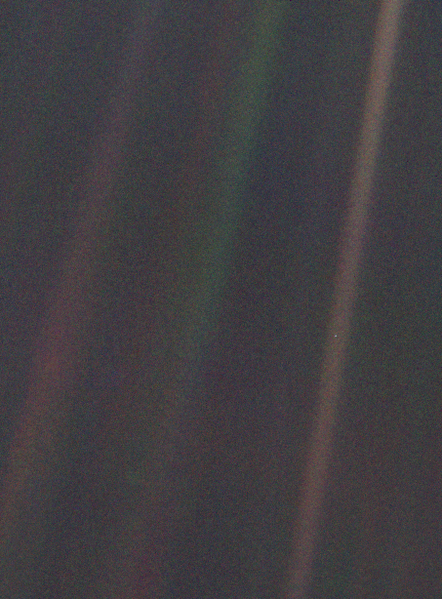
Here is one of my favorite pictures of all time:The Pale Blue Dot references a picture taken of Earth from Voyager 1 in 1990 from 6 billion km away. It shows how small we are and lends perspective on our place in the local cosmos. It transfixes me. Every time I hear Sagan's voice reading the famous passage from his Pale Blue Dot: A Vision of the Human Future in Space, my eyes fill with tears and I am overcome with emotions and inspiration.

If you look closely, you can see Earth in the brown band on the right, about halfway up. That is our planet. Stunning isn't it! Check out the Pale Blue Dot link above for a look at the wide angle shot which includes our sun.


Listen to Carl Sagan reading the famous passage from his book and see what you think:
http://www.youtube.com/watch?v=4PN5JJDh78I&feature=fvwrel

Being  musician, I am also thrilled about the Golden Record being aboard Voyager 1 and 2. It was intended to represent our world and its civilizations. Can you imagine that if something happened to Earth and the planets on and around which we have robotic spacecraft, this would be THE ONLY EVIDENCE of our existence! I do actually ponder that from time to time.The Golden Record contains scenes, greetings, music, and sounds from Earth. What would your selections be? Here is a link to all of the information on the records. If you ever get the chance to check out Murmurs of Earth by Carl Sagan, take advantage of it.

The Golden Record http://voyager.jpl.nasa.gov/spacecraft/goldenrec.html

Even MORE Excitement!
I have the great fortune to be attending a NASA Social event next weekend at the Goldstone Deep Space Network near Fort Irwin, CA in the Mojave Desert. I cannot believe the timing - so close to Voyager I being declared officially "out" of the Solar System. The DSN monitors 24 spacecraft, including the Voyagers so I am hoping to learn a great deal and to talk space with fellow #SpaceTweeps :-) Expect pictures and a lot of "woohoo" comments ; )

You can read my previous blog post on the DSN and our adventure here:
http://carsonia.blogspot.com/2012/09/nasa-goldstone-adventure.html


You can also follow both of the Voyagers on Twitter at:

@NASAVoyager
@NASAVoyager2 (This account tweets for both craft and gives distances from Earth)