Share

Showing posts with label mission. Show all posts

Saturday, July 8, 2017

E-care's Cafe Galilea in Atok, Benguet Province, The Philippines

In May, 2017, I visited the Episcopal Church in the Philippines and the E-CARE (Episcopal Community Action for Renewal and Empowerment) program. This program is the community development organization of the Episcopal Church in the Philippines. Its structure is based on the ABCD (Asset-Based Community Development) model of organization. E-CARE has its own governing body consisting of a board of trustees and a chairperson who is also the current prime bishop. Joel Pachao was elected prime bishop at the May, 2017 Regular Synod. I was inspired to visit the E-CARE program by colleagues in Episcopal Relief & Development, The Episcopal Church Global Missions office, and a seminary course in Environmental Ethics at Sewanee School of Theology!
Image may contain: mountain, sky, outdoor and nature
First, a bit of basic information....
Primary goals of E-CARE (from their website): Episcopal-CARE seeks to improve the quality of life for its partner communities in the Philippines, facilitating poverty-reduction by providing or enhancing the opportunities to make a livelihood, while simultaneously empowering the partner communities through its asset-based approach and its commitment to creating self-reliance and sustainability. It also hopes to serve as an example for other development organizations in Asia and across the world as to how to help alleviate poverty without creating dependence.
Image may contain: sky, cloud, mountain, tree, grass, plant, outdoor and nature
The metaphorical model for Episcopal-CARE (from their website):
The metaphorical model for Episcopal-CARE is the Sea of Galilee, which is a sea with both an inlet and an outlet and so both gives and receives water. This is contrasted with the Dead Sea, which only receives water. The Dead Sea, as one may expect from the name, does not sustain any life within its waters. The Sea of Galilee however, is a dynamic and vibrant habitat for life. The goal of E-CARE is to empower its partner communities to help themselves, to alleviate poverty and give the people access to basic entitlements, and then to help others along the same path. At the same time, Episcopal-CARE tries to raise the level of gender-awareness in its partner communities, by ensuring that women of the community are part of the decision making process as well as the management of projects, and that the women of the community will enjoy the benefits of their new project.
Image may contain: coffee cup and drink
While in the Philippines, I visited several villages (post links coming soon), two E-CARE communities, and two of the main E-CARE shops which work to promote and distribute products from community partnerships around the Philippines. One shop, coordinated and run by Jennifer Ong, is located on the diocesan campus in Cathedral Heights, Quezon City. The compound contains the Episcopal national offices, the campus and classrooms of St. Andrews Theological Seminary, and Trinity University of Asia.
Image may contain: fire and food
The second shop is attached to a fabulous restaurant and cafe called Cafe Galilea. The cafe is located along Halsema Highway in Atok, the Philippines. If you are traveling between Baguio City and Bontoc or Abatan, you will pass it near kilometer 22. Stop if you can and enjoy all that they have to offer. It is well worth it!
Image may contain: 1 person, smiling
Joyce Roman
The cafe was managed by Joyce and Kellan Lyman, one of the Young Adult Service Corps (YASC) Volunteers from The Episcopal Church, USA. Not only is the food excellent and affordable, the staff friendly and attentive, but they proudly serve to promote community development projects - cooking and selling foods and other items made in communities all over the country. The entrance the shop is below the restaurant. They also do professional catering. The restaurant has a perfect view of the mountains and a separate cafe with professional barista for a beautiful coffee before you head onward in your journey. When you eat there, you are directly helping to sustain local communities that are practicing sustainable growth projects and empowering many economically and culturally.
Image may contain: 1 person, smiling, standing     Image may contain: 1 person, smiling, standing
                        Arianne Aben, staff                                                          Kellan Lyman, staff


The local pancit is well-known and loved by all who have visited the cafe.
Image may contain: food
Pancit
Image may contain: 1 person, smiling
Cef Esong, Barista 
My trip was made possible by grants from The Episcopal Church, USA Global Missions office, the Seminary Consultation  on Mission (SCOM), and The Episcopal Church in the Philippines.
Image may contain: fruit and food

Saturday, October 17, 2015

Mandwa Mahal and Bhoramdeo Temples, Travels in India

Mandwa Mahal and Bhoramdeo Temples
(A visit on Tuesday, July 14, 2015)
Continuing our trek around Chhattisgarh, India, about 17-18 miles away from Kawardha, near a large lake and its dam, through the hills, tribal villages, and herds of cows, we headed toward the first of two temple visits. The village of Chairagaon lies there, among green trees and alongside very low foothills of the Maikal range. At each turn of the roads are goatherders, cowherders, but as there are hardly any people living in the area, one only saw these plus an occasional car or motorbike on the road.

Here is a link to what it is like while driving through the cows!
Mandwa Mahal is a small Shiva temple built in 1349 by Fani Nagavanshi King: Ramchandra Deva, after his marriage with the Kalchuri Haihaya Queen Ambika Dev'i. The temple is facing West. It is known as the Khajuraho of Chhattisgarh due to its resemblance to the famed temples of Khajuraho and that group of monuments.
It has several sections including one underground which is the "inner sanctum", accessed by steep stairs. Inside this, was a holy man sitting with candles, garlands, oils, and flowers.                          
One can make a prayer in 
the inner sanctum and leave an offering for Shiva or go outside to the stone figure and leave offerings and prayers.
Around the rear of the temple, one can see many roughly-carved figures of erotic couples in many positions of the Kama Sutra. The sign at the entrance to the temple ground stated that this represented a type of worship and influence of the cult of the contemporary period. The sign was so badly chipped, rusted, and destroyed that it can barely be read.


Next, we went a few miles further and came upon the Bhoramdeo temple complex. The area approaching the road to the temple had blockades and old advertisements for the temple. Apparently, the government is/was trying to make it into a tourist destination. A short walk from the parking area took us to a lovely lake with giant lily pads, swan boat rides, and a few vendors selling their wares in front of the temple.

The Bhoramdeo temple is a stone temple dedicated to a form of the god Shiva and built during the reign of Naga Vansi, king, in the early 11th century. The temple was built by Lakshman Dev Rai in the Paramara style of Malwa. Various kinds of art (I read "Vaishnava, Jaina, and Shaiva sculpture styles") are all found in the temple houses on the grounds. The temple itself is also said to be in Nagara architecture.
The temple complex is named Bhoramdeo after a ubiquitous tribal god Bhoram deo (a form of the Shiva god). As you approach and see the temple for the first time, it is quite striking! Large trees cover the grounds and some of the temple, bathing all but the tallest structures in shade.One can see how it was left to the elements for centuries without being widely discovered in the quiet solitude of central India. The main entrance faces east and the lesser two face north and south.
                     
The entrance sign reads: "The temple is equipped with a sanctum antechamber, a three-porched square assembly hall, a super structure of seven horizontal and vertical segments, four ante "fixesin". There is a superstructure above the porches and the antechamber. Outside along the sides of the temple, there is "a riot of images" depicting sex, war, dance, and music and this is supposed "to represent the ephemeral world of senses, giving way to the darkness, silence, and emptiness of the chamber (sign says "bomb chamber") inside where communion with God takes place".
                       
                      
Entrance to one of the lesser temple side structures (below)
                     
There are other small structures on the grounds that resemble 8th century brick temples of Chhattisgarh. There are a few small statues and images around the temple grounds that were assembled mostly from the Chaura village and represent 12th to 15th century. 

Then, there are some erotic statues and symbols of Shiva that are said to be from the destruction of the Khajuraho temple of the 10th-12th century. There are so many pieces that the Bhoramdeo temple is also nicknamed "The Khajuraho Chhattisgarh" as with the Mandwa Mahal structure.   
Sacred phallic Lingua surrounding an egg
Sacred lingua covered by a cobra's head - you can see where offerings have been left                              
According to the Director of Archeology & Culture and culture board in Kawardha, this temple is "one of the finest flowers of Medieval architecture". 
There was a gigantic Shiva statue on the hill across the lake, but it was VERY obscured by tree cover so I didn't get any photos of it. After leaving the temple grounds and making our way back to the ambulance in which we had come, we saw a large herd of cattle and could hear their bells. I treasure this video and I wish we could have stayed longer.
Video of grazing cows and their bells
Some had bells on their tales and others around their necks....bells of all sizes. It was beautiful and calming to hear them! It almost sounded like a faint gamelan orchestra coming to order, but also reminded me of the Buddhist temples in Katmandu, Nepal, where there is an occasional cacophonous time of instruments in between chants and prayers. This was more gentle and lovely though, and brought images of a distant time and the onset of quiet evening on the mountain in waning half shadow.

Monday, September 7, 2015

Teaching at the Rambo Memorial School and Working with the Nursing Students

Mungeli, India update: July 13- July 15
Yesterday was the New Horizons Pluto flyby - SO EXCITING! I told as many folks as I could about it and hope to check into the internet later on to see the news. It's very hard not knowing the play-by-play on this long-awaited and much-anticipated space event, but it'll never lose its cool factor and I'm positive images will be forthcoming from the massive amounts of data for at least one year following the flyby. I wonder if they will choose a Kuiper belt object for after the Pluto adventure!

Monday, I had my first classes at the Rambo Memorial School and things went well! I worked on singing with the 7th graders and we had lots of fun! As it turned out, I ended up teaching third graders through tenth graders in sometimes three and sometimes four classes each day. The littlest ones are SO CUTE and so polite! Each class stands when a teacher enters and except for the "usual suspects", most everyone pays attention and asks questions etc. My classes were offered as an "extra" and mainly for those students interested in learning about music and singing. Each class was absolutely packed. Most of the students liked the singing, but not all of them. This year, I had two classes without a teacher in there with me. I feel like I needed someone in there for the occasional question a child asked, for discipline a few times, and for translation of what I was saying and the instructions bring given to the class!


Everyone wanted to shake my hand and say "Good Morning Ma'am!" :-) A few of them dare each other to come up as I'm walking in the schoolyard and say "Good morning" or "How are you?"...I answer and they smile, giggle, and run.

Each evening, I work with the nursing students on singing technique and the songs they use for daily morning chapel services. I also prayer with them and help them in planning some of the chapels. I was also asked to speak several times which was a huge and wonderful experience for me! Neither the students at the school or the nurses at the hospital are used to singing in their head voices, so that's one of the things I'm re-introducing and trying to get them all to integrate. All of the Hindi folk music that I've heard has been in chest voice with some nasality, but it works well for the language and the songs which may have clapping and instruments going on.
Tuesday I taught three classes at the school. One class of grades 3-5, one of grades 6-7, and one of grades 8-9. The school has almost 200 new students this year, making for a rough total of 950! This is a fantastic trend, but they have almost no room as it is. Some construction is being done, but it appears to be rather slow. It is also very loud and going on all day during classes. They are using both the "new" and the old school buildings. I must add here that the new classrooms are overcrowded, filthy, and without proper ventilation (not to mention air conditioning). The old buildings do not have electricity. The bathrooms are unspeakable and a teacher even recommended that I not go inside. In spite of all these things, they are doing the best they can and providing a much-needed education for hundreds of children! The teachers are good and quite dedicated. It is very clear that they love their kids and get frustrated by the lack of proper facilities as well as the lack of resources in general.
After the school day, I rushed back to take a shower as it was BOILING HOT outside with at least 1,000% humidity and I was a big bowl of sweat. Dr. Anil Henry, the head of the hospital took thus year's group of missionaries to see two temples at the edge of a low mountain range. He had to go to the town of Kawardha first for a court case (a child hurt in a terrible auto accident died after two months in the hospital and he was there with the family to testify against the driver) so we went along for the ride and waited in the ambulance while he was in court. As if an ambulance pulling up to a courthouse wasn't enough, there were nine of us inside and all very different-looking so we periodically drew crowds of folks wanting to have a look at us. I found again this year that we were something of a culture shock to just about everyone. In most cases, people from the surrounding villages of any town or those in small towns seemed to never have seen anyone different from themselves, at least live and in person. After the court case was done, Dr. Henry took us to a very large dam and lake. We got out to stretch our legs a bit and then continued on to the temples (See next blog post).

Mungeli, India 2015

A Visit to Mungeli, India - Mission trip - Summer 2015
I've returned to the Christian Hospital Mungeli  and the Rambo Memorial School
This year, the internet was less consistent than last year so I emailed myself these blog posts and am just now getting around to posting them! 
It's Sunday in Mungeli and I'm back in my room after a trip to the local church down the road followed by a walk into the town. It is SO HOT! I needed a cool down break under some fans and with some water. I arrived in India last Thursday (MSY--AMS--DEL) and spent the night in the boiling hot & stuffy Delhi airport on a reasonably comfy bench until my early AM flight to Raipur. I was so sleepy that I got off the plane in Nagpur and thank goodness they checked my boarding pass and told me I needed to get back on board! Arriving in Raipur, I waited for my friend Kahala and the driver to come and pick me up for the ride to Mungeli. When they came, it was decided to stop at a grocery for some necessities some of the other visitors to the Christian Hospital needed and so picked up some lunch to go while we were there. The drive to Mungeli was full of a million annoying stops and so bumpy I'm surprised all my internal organs made it intact! The driving is actually pretty scary here. One must drive at top speed, dodging cows, dogs, people, motorbikes, cars, and huge trucks. Often, when passing another vehicle, it's an outright game of chicken, seeing who will give in to getting back in his lane. The other consideration in all this is the road quality. New Orleans, I hate to tell you this, but the state of Chhattisgarh has you beat, by a factor of about a million. The craters in the road are sometimes as big as your car and dangerously deep. You can usually dodge them, but if you accidentally go through the wrong one, you may destroy your car or truck. If people slowed down slightly, it would help, but I learned last year that everyone here is used to it all. I gave up worrying about it and just tried to trust that we'd make it. I figured the driver didn't want to die today so would be at least a baseline level of careful. Seatbelts might help. Maybe.
My first day here, I had to rest immediately and I later went to dinner to meet two girls from Denmark and four Americans (from Butler and Eureka colleges). They are a terrific group and we shared dinner in the guest house.
The next day, Friday, I had NO jetlag because I had beena wake for so long and slept like the aforementioned boulder! I attended the chapel at 7:30 AM and I was so surprised to receive such a fantastic welcome! The nursing students were all there and many remembered me from last year's visit!!! They are SO SWEET!!!!! At the end of chapel, I was introduced and one of the girls gave me a beautiful garland of marigolds!!!
Christian Hospital Mungeli
We left chapel all together to go downstairs and see the new medical equipment that had arrived. It's high definition and to be used for their Urology work.

                                           
I was asked to bless the new medical tools so I said a prayer asking for blessing and longevity of use as well as for God to guide the hands of those who use these new tools. 
Dr. Anil Henry, the wonderful head of Christian Hospital Mungeli and a great surgeon, said a few words about the equipment and showed them to everyone. 
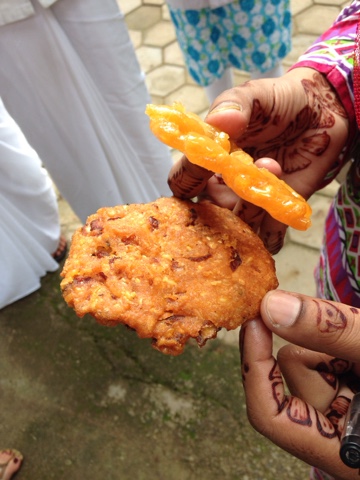
This was followed by DELICIOUS jelabies and spicy samosas. Jelabies are soft, honey-filled pretzely swirls of goodness. 
Samosas are little fried pockets of potato and onions and heavy spices. They give me heartburn, as most of the food here does. I also had taken my first Doxycycline pill (for Malaria prevention) and those tend to give me heartburn as well so I stayed with sampling the jelabies :-)
It was time for morning rounds in the hospital. Last year, I did this a few times and would stop back by sometimes in the afternoon to see some of the patients. The morning group consisted of Dr. Henry, one or two other doctors and nurses, and some of the visitors. I noticed there were several malaria patients this year, including one with cerebral malaria who was not doing well. Malaria is endemic to this area and is especially rampant during monsoon season. About halfway through the rounds, I actually began to feel quite ill. I thought I was going to have to throw up so I quickly left ICU and headed outside. The EXACT same thing happened to me last year on my first day. The Doxycycline gave me severe heartburn and some nausea and I did throw up. This time, I didn't throw up, but I realized I needed to eat something quickly or I would. You're supposed to take Doxy with either food or a milky substance and I had simply had a couple of crackers. I think that's why I didn't throw up though - at least it was something. So, I went to the guest house, where I stayed last year and where the Danes and American students are staying. It's also where Tripdte, the cook, makes Masala chai and meals. I ate an egg and felt immensely and immediately better!
After breakfast, I sort of made my own "rounds" and saw lots of familiar faces, visited the nursing students' classrooms, and came back after lunch for a nap, still exhausted from reflux and ok, maybe a tad bit of jetlag. I went in the early evening to work on singing with the nursing students and had great plans. The American students came too and we waited almost an hour, but no one came. We think the message didn't get through and that's my fault because while I made a small announcement, I didn't find the person in charge of their schedule. No matter, we went back to the guest house for dinner and had some fun conversations.
me in the middle w/ Issac and Grace, fellow missionaries
Saturday, I attended morning chapel and had breakfast. I visited various departments until lunchtime and then went back to my room to rest instead of eating. That Doxy is a MEAN and TERRIBLE medicine. In the afternoon, I contacted the school and then did some work for projects at home. Early evening brought a super fun time with the first-year (and four of the second-year) nursing students! We warmed up, something they've never done before! It made them think I am totally crazy, but I could tell from their giggles that some were enjoying being silly with their voices :-) Next, I talked to them about the differences between head voice and chest voice and when to use them. After I demonstrated it a few times, they did it with me. It will be a constant reminder during the next couple of weeks. I introduced two songs that the second-year students learned last year and they did them with pretty good success. Then, I talked to them a little about the functions of music in worship. We sang one of the songs I taught them and since we had reached the end of the hour, called it a night. 
My lovely nursing students!
Today, Sunday, my roommate Kahala and I went to the Mungeli church which is a Disciples of Christ congregation and attended their morning service.
Mungeli Christian Church
It was quite lively and about two and a half hours. I really enjoyed hearing so much of the Hindi language and getting to meet some of the townspeople, but I didn't understand a single word of the sermon and it was difficult to maintain concentration. There was a praise band and while it's not necessarily my preferred style of music, it was very moving to hear everyone singing together and wonderful to see people smiling. Afterwards, we walked the rest of the way into town and did some errands and looked around.

We ended up at a new store to buy laundry detergent and several people wanted to take a picture of me and with me and wanted to hand their babies to me for pictures. I did do some group photos, but handling babies was so not going to happen. I remember this happened at the Taj Mahal last year. I suppose I do look extremely different, being so pale and with a mess of red hair! it was a bit much today though so we left and came back to the hospital. This evening, we attended the hospital chapel and then went for dinner in the guest house. Tonight after dinner, all of the missionaries got together and went through our visit prayerfully and sang a few hymns. That was super nice. This particular group of missionaries is bonding very well.
Monday holds my first visit back at the Rambo Memorial School to see some social studies presentations, meet with some teachers, and to get started teaching some music classes. I think that I may be heading to Bilaspur on Tuesday afternoon  after school to see some temples and then eat at a roadside restaurant on the way back!

Friday, July 18, 2014

Mungeli, India Mission Trip: Working with the Nursing Students

In addition to teaching music and later, giving some spacey NASA-ish talks at the RamboMemorial School, I am getting to work with the nurses and nursing students for about 40 minutes to an hour daily. They are so wonderful and so sweet! I see them all around the hospital in the afternoons and evenings and they are always smiling and ready to say a hello and chat a bit or help me understand what is going on with a patient. My music sessions are to help with their chapel services and provide some instruction that can make the small groups better when leading the congregational songs. I am also helping them to consider adding some prayers and Gospel message and/or a few minutes of a mini-sermon / the word / a testimony from someone to the chapel services. At present, there are some extremely lengthy songs, one psalm, the Lord's Prayer, and more singing. The pastor that used to be on staff left last year so the service has morphed slightly is more like a prayerful singing time than a structured service (which is completely fine). I am hearing that some would like to incorporate more prayers and some would like less verses in some of the many lengthy songs.
I am teaching them about head voice, chest voice, and different styles of singing (basically some of the the same lessons I am doing in the school classes.) The nursing group also doesn’t know how to read music, but I'm teaching them some basics so we will make some progress! 

I noticed right away on the first day here in chapel that they sing everything by rote and most of the English songs are from a pretty terrible book of texts called “Adore”.  I think they think that I know all 500 songs in there, but I don’t. I know very few “contemporary praise songs”. They may not change their whole way of singing, nor should they, while I’m here, but at least they will learn a bit about reading music and some new songs. I am thinking of how I can send them some newer hymnals and/or some more musical materials. My hope for the music instruction that I am giving is to present the tools to continued independent learning in music and maybe one or a few of them might choose to pick up an instrument one day. The hospital owns a keyboard in the library where we are holding chapel services (b/c of the rains and flooding in the actual chapel) and Dr. Anil Henry, the head of the Christian Hospital Mungeli, owns one which I took to the school. Dr. Henry sings very well! He also seems to really have a love for good music and music in any style done well. He listens to the singers at the chapel services and makes good comments when he gives his morning announcements. I like him because he has a vision for this hospital, vision for the nursing students (both to be good nurses and to be confident and independent women who know their options in jobs and in life), and he is a kind and gentle man with a twinkle in his eye that tells me he has a sense of humor and is very observant.

I love hearing the nurses and students singing in Hindi. I am in awe of the lengthy melodies and all of the ornamentation that I hear. The style of singing reminds me of what I heard in my many visits to Bulgaria and the throat singing styles which are loud and chesty. Many people say that it's "flat", but I have heard Bulgarian (and now Indian) choirs as well as many others, that sing perfectly in tune using the throat singing as long as each sectional part is in perfect unison. Sometimes, I hear microtones as well, adding to the already eastern tonalities. It really sounds cool! I have some video from a couple of the morning chapel services and when the internet is back in full force (or maybe when I get back home in August), I’ll post some videos of some cool Indian music sung by these lovely ladies.

Mungeli, India Mission Trip, Working at the Rambo Memorial School

Today, I attended the morning chapel at 7:30 and then the nurse’s rounds. After breakfast, I wandered around a bit and headed over to the Rambo MemorialSchool. There are 750 students at the school in grades 1-12 and it is an English Medium School. After meeting with principal Avanash, I went with him and Prashanta to a classroom where they had gathered two classes together or fourth and fifth graders. I taught them a song: “Jubilate Deo” (attr. Michael Praetorius), hoping to get to where we could do it in a canon and then began telling them about the differences between head voice and chest voice and what bel canto singing style is. I talked to them about the differences between some kinds of folk music and what classical styles of music included. Then, I started teaching them some basics about music and notes. I showed them various kinds of notes, the staff, and lines and spaces.

They were SO EXCITED! After this, we sang Jubilate Deoagain and I went on to another classroom with two classes combined. After the same lesson, I helped one of the teachers with some phonetics and followed that with another class period of combined classes and then another! Whew! It was super fun, but intense. I wanted to make sure that I was not going too quickly for them as I was teaching in English. There were several teachers there in each class in case anything needed to be explained in Hindi. I thought about it in the third and fourth classes and had them take a fun selfie with me! There is one above and here is the other! 

After 7:30 chapel, followed by morning rounds with the nurses and doctors, I will be teaching three classes per day at the school and then will have sometimes have free time in the afternoons. In the evenings, I will work with the nurses and nursing students. I hope to give them some “new” songs, teach them a bit about reading music so that they can have the tools to continue learning on their own if they wish, and to have them learn the differences between singing chest / throat singing and using the head voice more. This is a huge HUGE concept to practice. In the midst of all this, I want them to laugh and have some fun :-) They are fantastic students!!

The school itself is partially new and there are construction plans ongoing. As far as I know, they do not have any instruments including a drum or a keyboard. Music is not a normal part of the curriculum either and everything I am teaching them is brand new for them. During the year, I am planning to try and get some people together to send some instruments that they can use and some basic music instruction books. If you would like to help me, please let me know at choralmusicrules@hotmail.com